TEH is entering its fourth year now. You’ll find some army list posts, some hobby thinkings and some painting tutorials. I hope you enjoy it!

My journey from terrible gamer to terrible gamer with more painted armies
TEH is entering its fourth year now. You’ll find some army list posts, some hobby thinkings and some painting tutorials. I hope you enjoy it!

Ok so this post is a bit of a cheat. As I write this I don’t actually know how I paint Ultramarines. But I’ve got a great system for finding out! These Ultramarines form my Kill Team roster. You can read about that here.
I’m at a bit of a bind with this. All of the ip art of the Ultramarines has them painted in flat blue. Having spent a lot of time playing 30K I really like the candy red finish that you see on a lot of Thousand Sons armies. I’ve got the idea to translate that to blue for my Ultramarines. What I’m going to do is test a couple of different candy metal tests against a few flat blue finishes and see what I like best. Then I’ll really know how I paint Ultramarines!
That is the question. Ultimately how I paint Ultramarines will decide on how I paint the trim (the pauldron edges, the eagle and the weapons). If I go down the candy blue metallic route, I’ll use TMM (mixing TMM and NMM on the same model looks shit). If I go down the flat blue route then I’ll use NMM.
How I paint Ultramarines depends on the top coat for the finish. I’m going to try Tamiya clear blue vs Vallejo Ultramarine blue, super thin in layers over the top of a strong basecoat. I’ve been here before with my Aeldari (here) so I have an idea of how this will work out but I’m a better painter than I was then so we’ll see. Whilst how I paint Ultramarines relies on the top coat for the final effect, it’s really the basecoat that decides the look.
Ok, I’ve got six Ultramarines built ready to test. Note that how I paint Ultramarines for the final models going into my army will be in small sub assemblies (heads off, backpacks off etc). These test models are all one piece so I can speed this process up. I’m not going to show building and priming Space Marines, it’s boring. but here’s the group shot:

Now here are the six base coat / top coat combinations I’m going to try:


This wasn’t very hard really and almost anyone with an airbrush can do it. I did the darkest base coat all over the model, the mid tone from a 45 degree angle above and then picked out the highlights with the airbrush. Here’s how they all look:


Ok so the next stage in how I paint Ultramarines is to apply the top coats over each of these. I’ll post about how I get on!
I’ve painted a Kill Team previously, for Grey Knights. You can find them here. Well now shit gets real because I’ve signed up for a one day Kill Team event in June (2022). Time for a reset – it’s Kill Team take two!
I’ve been paining Ogors for AoS for ages now and they’re turning into a grind (you can find them here). So I’ve got some fairly straightforward rules for choosing my next faction:
Ok – so I’ll have some posts coming up about picking and painting my Ultras but until then, peace out!

I’ve painted the skin of the Mournfang now. I haven’t written anything about that because I’m not sure I’m very happy with it yet. It’s very blue and quite bright which isn’t exactly what I wanted. I’m going to paint the tusks (painting tusks in 28mm isn’t something I’ve done before), the teeth, the noses and the eyes of the Mournfang and see if I need to adjust the skin tone after that.
The first thing I did before painting tusks in 28mm was to look at as many pictures as I could of different animals tusks. The Mournfang aren’t mammoths, the shape of their tusks looks more like those of warthogs than anything else. So I did a lot of research of warthog tusks. Actually the best image I found was on a site which sells bones. I won’t link it here because it’s gross. My point is that when you’re painting tusks in 28mm (or anything else for that matter) you should have some idea of what you want it to end up looking like before you start (and that’s where reference material comes in).
So breaking down the tusk into colour areas and shapes is actually pretty simple. The tusk is a basic yellow colour. At the bottom (where it joins the skull) it is dark brown and then all over but most densely towards the tip it has some white staining. All of this feels very achievable.

Alright, here are the three colours I picked;


Step one is pretty straightforward. It’s two thin coats of the Buff over all of the tusk
Step two is a bit more interesting. I think my Charred Brown way down and painted a decent amount of it onto the tusk where it joins the skull. Then I cleaned my brush (by ‘cleaned,’ I mean, ‘sucked,’) so it was wet but had no paint on it and voided the brown paint up the tusks towards the tip as if I was wet blending but really I was just pushing one colour in one direction and letting it fade out. After that I went back over the bottom of the tusks with the Charred Brown to get the base of the tusks really dark and to push the transition. Here’s how it looked:

When I look at my reference material, I can see that some of the dark colour at the base of the tusk actually runs all the way along the tusk to the tip. Step three was to add these lines:

Step 4 was to dry brush Wraithbone very lightly over the tusk so that it was left on the model but didn’t cover the dark lines:

Step 5
Step five is easy. Take a group photo and breathe a sigh of relief that with the tusks painted, the skin on the Mournfang doesn’t look so weird.
I’ve done six of these, I have a further six to do. Then I want to paint the rest of the faces (the eyes, noses, teeth) before I move back on to the Ogors themselves and probably have a crack at the cloth on their trousers.
Comments always welcome!
Exactly what’s been going on in my life over the last six years or so is between my therapist and I. The TL;DR version is, a divorce, the survival of a subsequent financially, sexually and physically abusive relationship, living in six different countries, finding my soulmate and a settling in a great job. The long version (of some of it) is here.
One of the things I’ve spoken with my therapist about a lot is intensity. Abusive relationships are extremely intense. Intense highs and violent, depressing lows. When I look back over what I wanted to achieve with TEH I think I can see some of this chaos reflected. The original intention of this blog was to motivate me to paint new armies and attend tournaments for new games, especially 40K. Then I wanted to improve my painting and have a crack at some painting comps. All of my aspirations were about competition and improving and measurement. Actually, I’m moving away from that now.
Maybe. But let’s boil this down. I have heaps of hobbies, I really do. But I don’t do any of them to win. Here are a few:
So why give it large on here about wanting to go to tournaments and / or win Golden Demon? I genuinely don’t know. So there’s a big rethink and reset for year four.
Now that the toxic intensity has been removed from my life, I speak to my therapist a lot about how I’m a six out of ten and that’s exactly what I want. Less intensity, more room for emotional range and less pressure. It’s called transactional analysis. I’m ok, you’re ok. I can’t make you be more than ok by making myself less than ok and how ok I am is independent of how ok you are. It’s going to be like that between the hobby and I from now on.
I love painting miniatures because it’s a creative outlet, I love trying new techniques and I love the physical process of putting paint on models. I’m going to spend this year focusing on that (with some goals attached which I’ve already mentioned here). Once this hobby has become a part of “I’m ok, you’re ok” then I’m going to re-evaluate.
It’s all about the process and mediocrity for this year. Sounds fun!

Ok, this is a bit disingenuous. I’ve been an airbrusher for a while. Regular readers will know I lost all of my hobby possessions a couple of years ago. That included my airbrushes and compressor. Now that my circumstances have changed, I’m starting to airbrush all over again. This is a short story of how you can get into starting to airbrush relatively inexpensively.
It took me a long time to get an airbrush originally. I painted my entire EC army with a hairy brush:


but since taking the plunge I can really see the benefits. My airbrushing requirements will still likely be limited to fairly agricultural jobs:
but maybe I’ll try and expand the repertoire a bit for my current projects. But, effectively, even if I never use it for more than this list, it’s a huge time saver and a great tool to have. It does mean, also, that I’m not really in the market for a 0.15mm nozzle super brush – I won’t be doing any freehand with it that’s for sure
Through no fault of theirs, my favourite online gaming store (Element Games) have been unable to send me the really posh airbrush and compressor set up I’ve ordered. I think it’s a Brexit / Covid thing. My parcel got stuck in customs twice then returned to the UK. So, back in the UK right now I have a lovely Iwata airbrush and compressor waiting for me. But I need to be starting to airbrush right now…and a little bit of luck has come my way. I was passing a newsagents in town recently and my eye was drawn to some kits in the window. Turns out this isn’t a newsagent with some scale model kits as a side hustle. It’s a model shop that sells newspapers – hurrah!
My new local model shop sells everything I need for starting to airbrush so I’ve loaded up. There’s a lot of overlap with the stuff I’ve had sent to the UK from Element but that’s ok, I’ll worry about that as a future problem. The thing I’m really here to tell you about first off is the airbrush and compressor I’ve bought:


At £140, this compressor is less than half the cost of the Iwata model I’ve ordered. I’ve never used a tank compressor before (this one is 3L). I’ve always had an ‘always on,’ compressor. It’s never bothered me before so it’ll be interesting to see the difference. Similarly the airbrush was very reasonably priced (£35 – about 1/3 of the Iwata brush I’ve ordered).
Straight out of the box the compressor needed some work. Every joint in the line from the tank to the brush leaked, but liberal application of PTFE (I think it’s called Teflon tape in the US) and that’s no longer a problem. I will say now that using the tank compressor over an ‘always on,’ model made no difference in terms of performance from what I could tell. I’ve never noticed any pulsing from the ‘always on,’ so that was never an issue. I like the fact that the tank means the compressor is quieter but I did find myself getting startled when the motor restarted as the pressure dropped. Overall, I neither prefer or have an issue with the compressor and for £140 that makes it great value in my eyes.
The airbrush was the real star for me though. AK is a big brand so I didn’t expect it to be garbage at all but I did expect to feel a difference between this and the more expensive brushes I’ve owned in the past. Actually, no. Now I will say that I don’t get clogged brushes or dry tip because I use super thin paint (and you should too, here are some recipes). So I can’t tell you whether this brush is more or less prone to those problems.
What I can tell you is that the cup is plenty big enough, there’s tension in the trigger so you get lots of feel from it and it seems to be very well made. It’s dual action and gravity fed – the two big things that are important to start with (it’s beyond the scope of this little piece to tell you what that means, either look it up or trust me; you want a brush that’s dual action and gravity fed).
I’ve primed the Ogor mounts so far and I’m very pleased with the results:


I’ve also gone a lot further than this with a military model kit (apologies, I know this isn’t what this blog is for):


There are a few airbrushed steps with this model so far:
There are a couple more airbrush steps (I’ll gloss varnish again before I weather it then I’ll matte varnish on top of that to take the shine off before I do the last details with a brush.
So, if you want to know how to do a basic colour laydown with an airbrush (especially priming) then have a look at this. If you want to know if you can get into starting to airbrush with this, relatively modest, set up – it’s a big yes from me!
Comments and queries always welcome.

I’ve already written a piece on prepping a miniature for your best result (you can find it here). That was with specific reference to single miniatures but describes why priming is more complex than laying down a single colour. Effectively, I’m describing zenithal priming; creating a monochrome value sketch to help the next stages of paint pop. Well today I went ahead and primed all of the mounts in my Ogor Mawtribes army. The big difference is that for the army I’m priming with an airbrush. It’s a bit different to priming single miniatures with a brush and I’ll also do something that I don’t really like doing (no, not that you creep); I’ll give you some specific recipes for paint and additives. This relies on you also using Vallejo for all of this (as I do). Don’t blame me if these ratios are all wrong for other brands.
My OM army is built and pre-primed (a stage I invented because mould lines only seem to show up when you put paint on a miniature so I added a paint step just to show up mould lines). You can see them here actually. They’re basically ready for priming with an airbrush.
I’ve basically got a fairly short list of items for priming with an airbrush and I don’t deviate:

I got most of this stuff from Element Games but there is a bit of a crunch on Vallejo paints at the moment, they are quite hard to get hold of so you might have to be patient.
This is not a tutorial on how to clean your airbrush or how to use an airbrush. I do, however, have a couple of bits and bobs handy whenever I airbrush (not just priming with an airbrush).
I do also want to make a quick note on air pressures. Compared to other painters and other things I read on the internet, I use very low air pressure (and a 3mm needle for everything). All of the steps below were shot at around 8psi. I read a lot of stuff about people priming at 30+ psi. I just find that insane. Along with very low pressure, I also use very, very thin paint. The two go hand in hand for me.
If I used higher pressure with my paint mixes, I’d get spidering and pooling and the whole thing would go to shit. The key here is the thin paint. Get your paint thin (as per the ratios below if you’re using Vallejo) and the low pressure will follow. Thin paint is always good. It goes on smoother, it drys better, it looks better and it makes cleaning your airbrush easier. It’s an airbrush, not a fire hose – there’s no way it should be shooting at >10psi.
Right, here it is. Step one to priming with an airbrush is a consistent, even coat (actually two coats) of black primer, all over the model. If you are using Vallejo primer AND Vallejo thinner AND Vallejo flow improver then my personal recipe for this stage is 8 parts thinner, 8 parts paint, 1 part flow improver. After two coats (it’s imperative you leave the first coat to dry before applying the second) you end up with this:
Grab your dry, black primed miniatures and strap in. The next step is a grey coat, at approximately 45 degrees to the miniature from above. What you’ll get is a black miniature if you look at it from the bottom, a grey miniature if you look at it from the top and a mixture of the two when you look horizontally. Kind of like this:
The ratios are the same for this step as step one: 8 parts thinner, 8 parts paint, 1 part flow improver. Crucially, you only need one coat of the grey or you’ll cover too much of the black.
This shouldn’t be too much of a shock but there is a small change in the ratios for the next step so pay attention! Once the grey coat is dry, take your white paint in a ratio of 8 parts thinner, 10 parts paint, 1 part flow improver (the white is less pigment dense than the other two colours so needs slightly more paint to thinner). The white then gets shot directly from above the miniature to catch the top of the model and the highest highlights. What you’ll be left with is this:
There are two more steps that you can find in my prepping tutorial. These guys will all get a dilute wash of some kind of brown (probably brown ink given how much coverage I need; it’ll cost a fortune in Agrax Earthshade!). Following that they’ll all get a light white dry brush on the highest areas to establish the most acute highlights again before the next stage.
Comments and queries always welcome!
Ok so 2020 was a dumpster fire globally. TEH did a lot better than most out of it:
Great question. Well, I’ve added a few posts in the last year with some ‘How I paint,’ articles (here’s one for starters) and some musings but, the nub of it all is that I ran out of material. Finances were crunched, Brexit and Lockdown fucked up deliveries to where I live so I was left pre-priming some ogors and then…not a lot. Well fear not! I’ve found a great FLGS in my city and restocked on hobby supplies (more on that to come) so, hobby time is back on!
Here’s a (non exhaustive) list:
I hope you enjoy joining me along the way!

Ok so I’ve managed to use some of the Christmas down time to crack on with my Ogor Mawtribes army. I have…
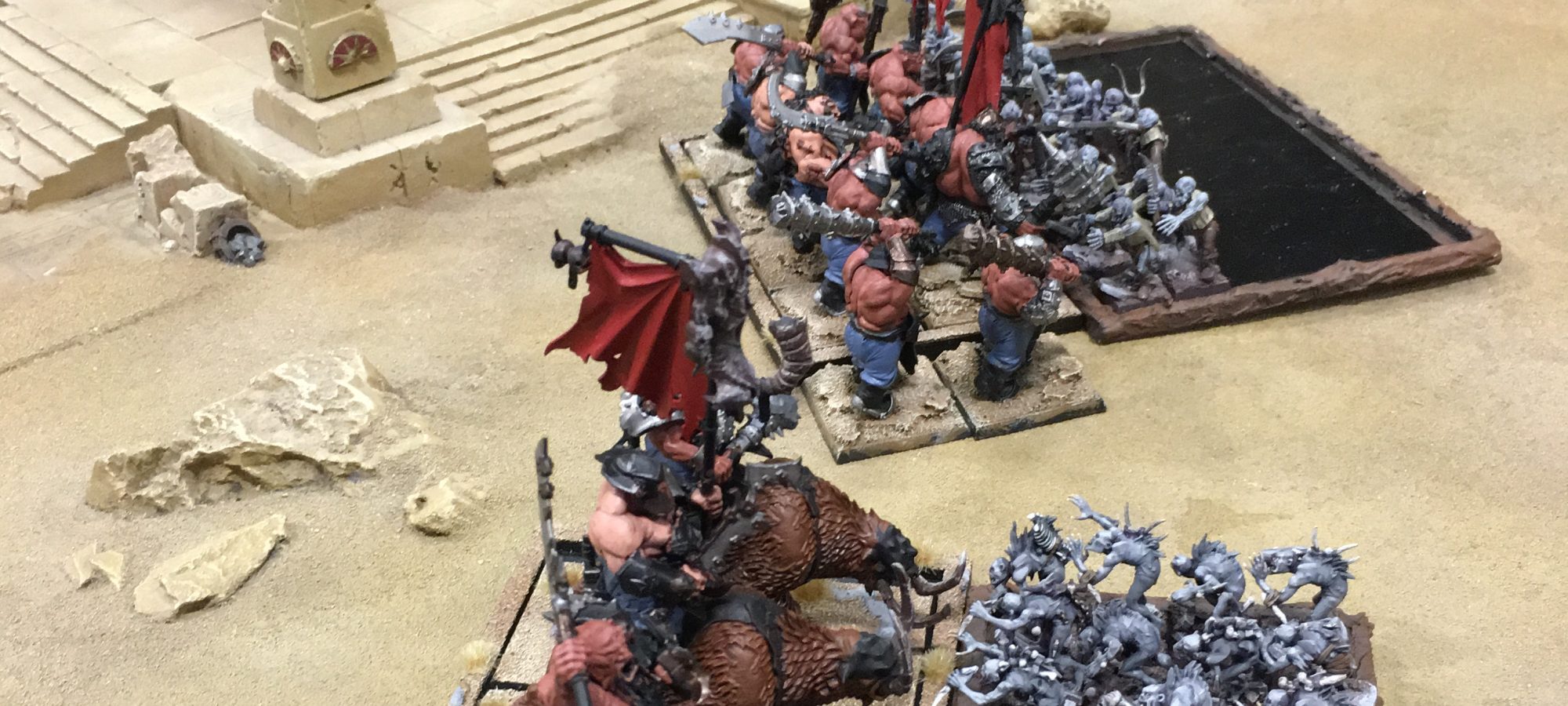
The result is in the image at the top. It’s exciting to see all the models in a group shot!
I’ve always had an issue with mould lines and gaps. I never spot them until after models are primed (or worse, after they’re progressed). Well I’ve kind of taken that rule and invented a ‘pre priming,’ step. I use a rattle can to give a coat to the miniatures, then inspect them for imperfections I’ve missed so far. I do think that not seeing mould lines until a miniature is painted is a real thing, not just a meme. Maybe it’s because during building, the grey plastic gets stressed and discoloured. Also, I guess we can just go a bit blind to staring at the same model in the same colour during building for hours. A rattle can layer smooths everything out and gives a kind of clean slate to look for mould lines.
Ultimately, the next step is painting the Ogor Mawtribes and I’m really excited. But there are a few things to think about before I really get into that:
This is probably my last update for a while as without the bases or paints I can’t progress. I’m going to use this time to develop the new, more ambitious aesthetic and have a think about basing.
Comments always welcome

I’m building an Ogor Mawtribes army right now (the latest update is here). In fact I’ve been collecting it and building it on and off for around 18 months now. I really like the Ogor kits from GW, but they do leave quite a lot of gaps between parts. Here’s how I’m fixing them using Liquid Green Stuff which is made by GW and sold here.
I’ve seen this quite a bit actually. Lots of moaning that liquid green stuff doesn’t fill gaps, the coverage is weak etc. Well, there is a method when you’re using Liquid Green Stuff and it includes a hobby tool that lots of hobbyists I know don’t have; patience. If you’ve got the patience to do it properly then using Liquid Green Stuff is a great way to fill some pretty serious gaps in your kits. There are steps to this process. If you’re expecting using Liquid Green Stuff to be a case of ‘slapping it on, job’s done,’ then you’re in for a shock.
I’ve been using Liquid Green Stuff to fill the gaps in my Ogors since I started collecting them so it’s not like I now have a whole army to do. However, the three Mournfangs I’ve filled today (Ogors and mounts) took me about 2 hours. So, I guess it’s probably a 20 hour job for the whole army. If you have a horde army, it’s likely not worth it. Smaller models don’t show gaps so readily and a horde would probably be time prohibitive (unless you’re looking for a painting award). So, I guess, large models (army centrepieces) or any display model makes a good candidate for using Liquid Green Stuff to fill any gaps but not your regular infantry.
Righto, before we get started, go an grab:
Here’s an example of a hole in the leg of an Ogor (caused by clumsy snipping from the sprue).

I also don’t like the very deep, obviously kit part gaps between the muscles. They are a part of the GW Ogor range aesthetic and you can’t get rid of it completely but in some instances it doesn’t look great:

These are two examples of the sort of gaps you can fix using Liquid Green Stuff.
Dampen your brush, load it with Liquid Green Stuff and apply it to the gap. Two things to consider here:

Along with the fact that using Liquid Green Stuff properly takes several layers, the requirement for patience also takes into account that Liquid Green Stuff has a drying time. I give a layer about 10 minutes to dry (another reason. to keep the amount you use small, thicker layers will take longer to dry). Curing takes longer still and after this process, I’d strongly suggest giving the models a couple of days to cure before you put any paint on them. But, as I said, about ten minutes is long enough for my layers to dry. You can tell when it’s dry enough to move on because it loses its wet ‘sheen,’ and looks matte. Like this:

Using a small amount of sandpaper (I tear of an amount about the size of a 50 pence piece) sand the excess filler off of the model. Here’s what that will look like:

What do you notice? The gap is still there. It’s smaller but it’s still there. So you have to repeat the process again. And maybe again. And maybe again after that. I used between two and four layers on the gaps on these guys. It’s always more than one. I think if you get to double figures then you’re doing it wrong but, to reiterate, this is about patience.
Here’s the same gap after another couple of layers:

After using Liquid Green Stuff, the difference in colours looks really harsh and the whole thing still looks pretty crappy, it’s just that there aren’t any holes in it any more. I would just counsel that doing this properly is part of a relatively high end of miniature preparation and that there are still a few steps to go before even thinking about final colour layers here. Miniatures always go through a phase where they look worse before they look finished. In fact that’s usually the case with every stage in a high end finish and this stage is no exception. But, if you’ve got gaps to fill in your miniatures, using Liquid Green Stuff is a great way to fill them, if you’ve got the patience!
Comments always welcome!

Regular readers of this blog (looooool) will know that I built a 1,000 point Beastclaw Raiders list for a doubles event that I ended up not attending. How I wrote that list is here. Well now, after a long break, I’m looking to complete the Ogor project so this has morphed into an exercise in 2,000 point Ogor Mawtribe list building!
Ok, so my approach to list building per se hasn’t changed all that much from the post linked above. In essence:
As I try and lift my Ogor Mawtribes list to 2,000 points there are some practical things that encroach on the process of Ogor Mawtribe list building:
What to do with 750 points when Ogor Mawtribes list building?
A great question. Well, I’ve mentioned the Start Collecting! box earlier here. It’s absolutely brilliant value. It’s £55 full RRP but I got mine for less at Element. In the box is a Stonehorn / Thundertusk kit that you can build any of the units that use these mounts from and four Mournfang. The saving against buying these separately is significant (£22.50 saving which is nearly 30% at full RRP) and if you’re going full Beast Claw Raider then you’ll need everyone of these models in your army, every single time.
Of course there is! One of the places I’m weakest in this list (in that it doesn’t exist) is Magic. I could get a Huskard on Thundertusk in this list. That plus four more Mournfang takes me to 1,870 points. That means I could take another two Mournfang and get to 1990 points. However, there are two things that hold me back from that:
So I’m going to go this way and suck up the lack of magic using items (or some other way, we’ll come to that).
General: Frostlord on Thundertusk
Hero: Huskard on Stonehorn
Battleline: 3 x 4 Mourfang with full command
Battleline: 1 x Stonehorn Beastriders
Adding in the Eurlbad battalion brings that all up to 1990 points (great year by the way).
Righto, with the models, battalions and points all fixed what gaps do I have and how can I fix them as i work through the abilities, items and attributes in the book?
Frostlord Command traits. Ok, I hadn’t read this properly. I can make my general a Priest (which is good because there’s a mortal wound snipe they can do) but priests can’t dispel (which is something I would like to add). So, ultimately, I’m going to use the trait that means I can use command abilities without spending a point.
Relics. I can get some magic resistance here. The artefact, “Skullshards of Dragaar,” gives me an auto dispel once a battle. It’s probably not as good as some of the other relics but it does fill some of the magic gap so feels sensible (like eating broccoli I guess)
Mount traits. Golly there are some goodies in here! Because I’m using Boulderheads, all my mounts (two Stonehorn and a Thundertusk) get traits instead of just one. I’m going for:
-Metalcruncher on the Huskard
-Belligerent Charger on the Beastriders and
-Rimefrost Hide on the Frostlord
The Mawtribes. Ok, there are two obvious ones here. Thunderheads would make my Mournfang better but Boulderheads would make my monsters better. Given that I’m spending 200 points more on monsters than Mournfangs that feels like a better bet. There’s some wastage here as part of the tribe ability makes priests better but that will have to pass
Thanks for asking! What I end up with is an army which has some really great points:
And what about the downsides?
There’s an obvious one and it’s the magic phase. I can auto dispel one thing per game. The hero phase isn’t a disaster in and of itself but the lack of magic is an obvious hole in the list.
Well, I’ve actually put an order in for a SC! box so when that arrives (should be in the next ten days or so) I’ll have all the models I need for the army and just need to start building before I move onto the phase (painting) which will lead me down another rabbit hole (buying a new airbrush)