
There are probably many different views about what constitutes an all comers list so I shall begin this week’s article with how I would define the concept. The all comers list (ACL) is one designed so that, in the most possible circumstances, it will still compete with whatever is on the other side of the table. In the previous article we discussed some of the counterpoints to this method, specialising in various aspects of the game to the exclusion of others. A number of core concepts tend to be at the heart of most ACL list building, this week we will look at those concepts, why they are important and how to action them when you are building your own lists.
Mobility is an important and often overlooked element of list building. I do not mean by this the mobility of individual units but of the whole army on the table top. When building a list, it is a good idea to imagine it deployed at one end of the table and try to envision where it could get to in 5 turns of a game while retaining its cohesion as a fighting force. You will see quickly which units will be able to move freely and which will struggle to reposition. Which units fall into each category will have a profound effect on the efficacy of the list. It is important to note that this does not mean that a whole army must be mobile at all times but that both the individual units and the army as a whole should be able to perform well and in concert as the army moves. An interesting side note on mobility is that often lists that seem like they will be very fast, in fact, are very limited, usually because they get their speed from special rules or deployments (drop pod armies are a good example of this phenomenon).
Durability of a force is paramount to any list whether it is an ACL or otherwise. The way to achieve this, however, is not always so clear. There is always the temptation, when seeking durability, to fall prey to one of the less flexible archetypes that we discussed last time. The most basic elements of durability are saves, armour values and numbers. Obviously the better the save, the higher the armour and the greater the numbers the more durability is gained. In the face of the many potential threats you are designing for (the “all” in all comers) it is important to avoid the temptation to move solely in pursuit of one of the three. Something I have seen time and time again is lists that focus exclusively on one of the three elements making the lists vulnerable to hard counters. A mixture of the three will serve much better in protecting against the wide array of threats that may present themselves.
Firepower, like durability, is best in balance. 30k has a wide variety of weapons available for you to choose from. Broadly, it can be split into anti-tank (AT), anti-infantry (AI), anti-air (AA) and hybrid, so let’s take a closer look at them. AT is absolutely essential to any Heresy list. Realistically speaking, if you want to be able to take all comers you need to be able to deal with heavy armour, specifically a Spartan. The Spartan is the most common heavy assault vehicle in the game and not having a plan to deal with one is a serious mistake. Trying to take down a Spartan from the front is a non-starter most of the time, the flare shield is simply too tough to make it any more than a shot in the dark. This is where we need to combine a couple of elements as you will need mobility to help you achieve your goal. Having AT weapons on mobile platforms is both advantageous in firepower and also opens up a lot of tactical flexibility. AI weaponry is the red headed step-child of heresy. The heart of the problem is that most units that can hurt armour can also hurt infantry but not vice versa. Dedicated AI is usually points wasted on hybrid AT/AI weapons that will do both jobs. That said, don’t fall into the trap of bringing so much pure AT that you don’t have the volume of firepower to deal with infantry when you face it in large numbers. AA is honestly optional; some people swear by it but it really depends on your local club/event scene. Most events I have been to there has been very little of it so I would not break up a well constructed list to squeeze it in.
Combat potential is going to be your secondary source of damage output in most but not all lists. Without special legion rules or units most armies struggle to create an all comers list with purely or mainly combat elements. That being said, the combat component of an ACL is absolutely essential, to the point of being almost necessary. Combat potential breaks down into 3 subsets: frontline assault, precision assault and counter attack; many units will potentially cover more than one of these roles. Frontline assault is, more often than not, terminators of some kind with a character in a Spartan (or possible a drop pod of some kind). Their job is fairly obvious and straightforward, to apply pressure to the front of an enemy force with a unit that has great survivability and damage potential. Precision assault units would include assault marines, veterans and smaller terminator squads in Land Raiders; they are probably not tough enough to charge headlong into the middle of your opponent’s force but if you can get them where they need to be they will easily take out key targets. Counter attack units would include breachers, veterans, terminators and dreadnoughts. These are your containment and board control units, they are there to keep your opponent back and make them think before they hurl their army at you wholesale. All of these elements can have a place in an ACL and as I mentioned earlier I feel that at least some combat potential is needed. Probably either frontline assault or counter attack with precision assault being a more specialist niche but a very useful one if you have the player skill to make it work.
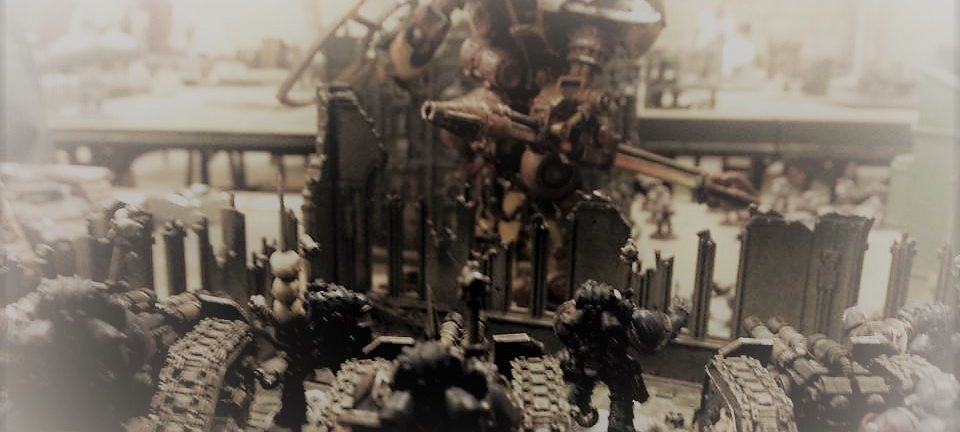
Lords of War are a big part of 30k, whether it’s a Primarch bestriding the battlefield, an enormous tank or a giant stompy robot of some kind. When fighting against them it really is as clear cut as the Spartan problem mentioned earlier, you must be able to kill them. Primarchs are a slight exception to this as they can often be contained, however, the way you would go about that is usually by killing their Spartan and the tools to do that are often the same as you would use on a super heavy. There are a lot of ways you can kill a super heavy but the first step is always this: don’t be afraid of them! So many players will look across the table, see a super heavy and count themselves out of the game. If you do this, you are being a big part of the reason that super heavy is doing so well, you have psyched yourself out over it. Honestly, there are maybe one or two super heavies that are a bit too cheap, most are well pointed and then quite a few are over costed (and rarely seen). When taking them yourself, go for something that has good hybrid weapons (a plus of a lot of LoW) or covers a weakness in your list. Try not to spend huge points on something you already do well.
Finally, we have talked about a lot of the things you want to include and some of the major things you need to be able to counter. However, there are a few things the ACL will not be able to deal with and you shouldn’t try and make lists that do. There is no point trying to build to counter Custodes, Magnus or haywire spam/Vultarax Mechanicum lists. These are elements of the game that will only be fixed with a rewrite of their rules. If you try and build lists that counter them, you will end up doing one of two things. You will either end up with a list that is too focused (and therefore weak in other areas) or you’ll create such a hyper optimised list that people won’t want to play you. Apart from those caveats I would definitely recommend taking up the challenge of building an ACL. It can be tricky but the end result is an interesting and rewarding list to play that will keep you hard for Heresy! Next time we will be going over some specific lists in the light of the last few articles, so join me then.
Until then, dear reader, the Emperor protects.