
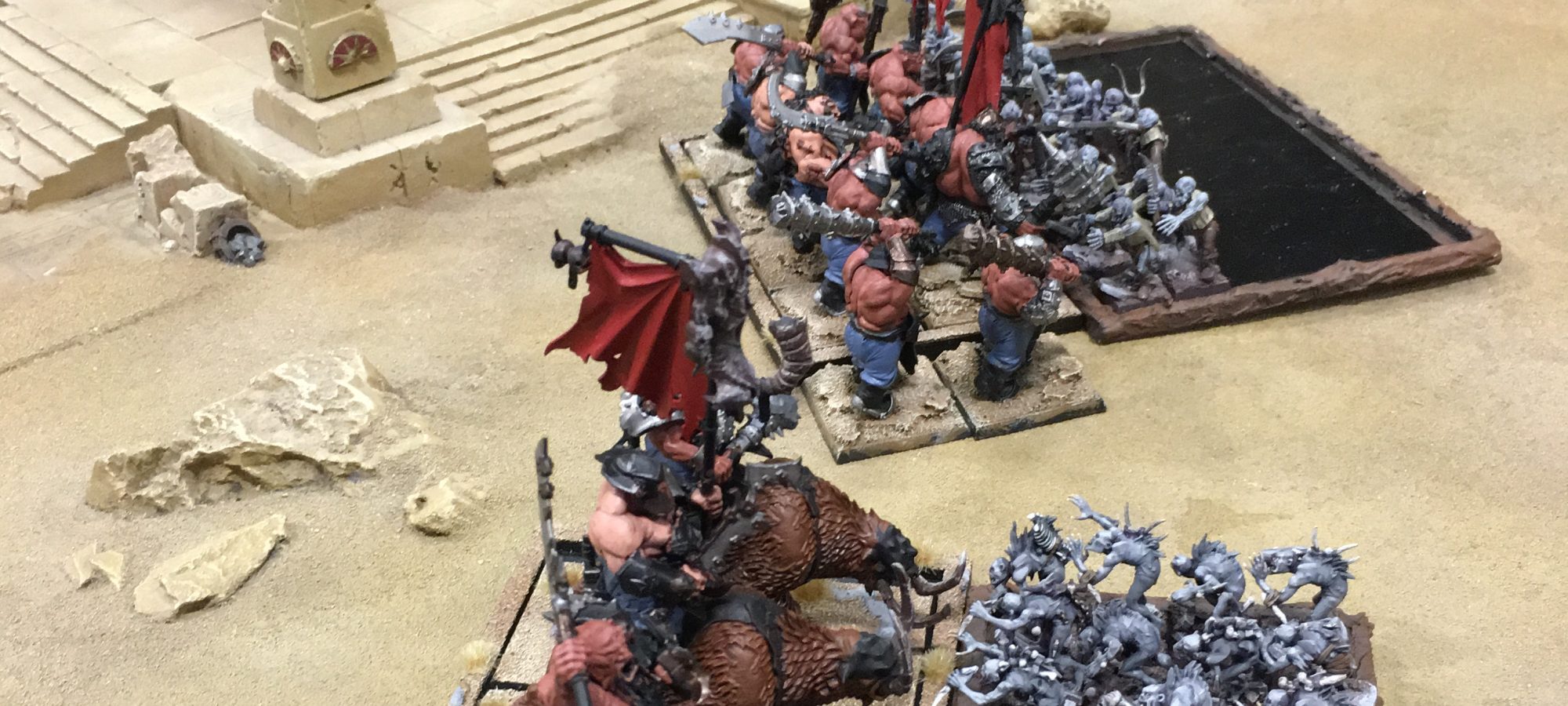

I’m building an Ogor Mawtribes army right now (the latest update is here). In fact I’ve been collecting it and building it on and off for around 18 months now. I really like the Ogor kits from GW, but they do leave quite a lot of gaps between parts. Here’s how I’m fixing them using Liquid Green Stuff which is made by GW and sold here.
But using Liquid Green Stuff has a bad reputation right?
I’ve seen this quite a bit actually. Lots of moaning that liquid green stuff doesn’t fill gaps, the coverage is weak etc. Well, there is a method when you’re using Liquid Green Stuff and it includes a hobby tool that lots of hobbyists I know don’t have; patience. If you’ve got the patience to do it properly then using Liquid Green Stuff is a great way to fill some pretty serious gaps in your kits. There are steps to this process. If you’re expecting using Liquid Green Stuff to be a case of ‘slapping it on, job’s done,’ then you’re in for a shock.
When should you be using liquid green stuff?
I’ve been using Liquid Green Stuff to fill the gaps in my Ogors since I started collecting them so it’s not like I now have a whole army to do. However, the three Mournfangs I’ve filled today (Ogors and mounts) took me about 2 hours. So, I guess it’s probably a 20 hour job for the whole army. If you have a horde army, it’s likely not worth it. Smaller models don’t show gaps so readily and a horde would probably be time prohibitive (unless you’re looking for a painting award). So, I guess, large models (army centrepieces) or any display model makes a good candidate for using Liquid Green Stuff to fill any gaps but not your regular infantry.
What tools do you need when you’re using Liquid Green Stuff?
Righto, before we get started, go an grab:
- A bottle of Liquid Green Stuff
- A small, cheap brush that can hold a point. You won’t be able to paint with this brush after you’ve been using Liquid Green Stuff with it but it can’t be such a bad brush that you don’t haver control over the tip
- Some modelling grade sandpaper (I’m using 600 grade dry sandpaper from AK
- A pot of water
- Some tissue paper
Step one – mind the gap
Here’s an example of a hole in the leg of an Ogor (caused by clumsy snipping from the sprue).

I also don’t like the very deep, obviously kit part gaps between the muscles. They are a part of the GW Ogor range aesthetic and you can’t get rid of it completely but in some instances it doesn’t look great:

These are two examples of the sort of gaps you can fix using Liquid Green Stuff.
Step Two – apply a layer of Liquid Green Stuff
Dampen your brush, load it with Liquid Green Stuff and apply it to the gap. Two things to consider here:
- How much is enough? As long as you’re not covering all the detail, you can put on as much as you like. However, the way Liquid Green Stuff works is that it shrinks as it dries. Then you sand the excess off. So, ultimately, the more you apply, the more you’ll waste. I find it easier to apply a small amount several times. Small amounts also dry quicker (‘quicker,’ doesn’t mean ‘quick,’ as you’ll see shortly).
- Brush direction is important here. Take the gap between the muscles on the photo above. You could run the green stuff along the gap itself using the tip of the brush. I don’t do that, I’ve found the using Liquid Green Stuff is easier if you drag the brush across the gap so that Liquid Green Stuff is deposited on both sides of the gap as well as in the gap itself. This makes sanding easier and also means that the Liquid Green Stuff becomes a part of the texture of the model more completely and doesn’t look like gap filler. Sounds weird but trust me. Here’s Old Mate again:

Step Three – Have a bit of patience.
Along with the fact that using Liquid Green Stuff properly takes several layers, the requirement for patience also takes into account that Liquid Green Stuff has a drying time. I give a layer about 10 minutes to dry (another reason. to keep the amount you use small, thicker layers will take longer to dry). Curing takes longer still and after this process, I’d strongly suggest giving the models a couple of days to cure before you put any paint on them. But, as I said, about ten minutes is long enough for my layers to dry. You can tell when it’s dry enough to move on because it loses its wet ‘sheen,’ and looks matte. Like this:

Step four – sand off the excess
Using a small amount of sandpaper (I tear of an amount about the size of a 50 pence piece) sand the excess filler off of the model. Here’s what that will look like:

What do you notice? The gap is still there. It’s smaller but it’s still there. So you have to repeat the process again. And maybe again. And maybe again after that. I used between two and four layers on the gaps on these guys. It’s always more than one. I think if you get to double figures then you’re doing it wrong but, to reiterate, this is about patience.
The finished article
Here’s the same gap after another couple of layers:

A few closing points
After using Liquid Green Stuff, the difference in colours looks really harsh and the whole thing still looks pretty crappy, it’s just that there aren’t any holes in it any more. I would just counsel that doing this properly is part of a relatively high end of miniature preparation and that there are still a few steps to go before even thinking about final colour layers here. Miniatures always go through a phase where they look worse before they look finished. In fact that’s usually the case with every stage in a high end finish and this stage is no exception. But, if you’ve got gaps to fill in your miniatures, using Liquid Green Stuff is a great way to fill them, if you’ve got the patience!
Comments always welcome!
2 thoughts on “How I paint 28mm miniatures; Using Liquid Green Stuff.”